The Tax Day Hangover
The Financial Illusion Hiding in Your Tax Refund.

What Tax Season Reveals And What to Fix Before Next Year
Some of you may have had this notification appear on your phone sometime in the last two weeks.
“Your federal refund has been approved. Direct deposit incoming. A few business days”.
And something shifted in you. A small exhale. The particular satisfaction of money arriving when you weren’t actively expecting it on a random Tuesday afternoon. For a lot of people, the tax refund feels like the universe finally coming through on something it owed them.
But the thing is, the money the government just sent you was yours the entire time.
This is what I’m calling the IRS hangover. Not the exhaustion of filing season, though that is its own special kind of misery, but the low-grade financial fog that settles over most Americans after April 15. The feeling that something important just happened, that you came out ahead somehow, when in reality the ledger has barely moved at all. Understanding why that feeling exists, and what it is actually telling you about your money, is worth more than the refund itself.
The Loan
Here is what a federal tax refund is, in plain language.
Every paycheck, your employer withholds a portion of your income and sends it to the government. This is estimated tax withholding, a calculation based on the W-4 you filled out, often years ago, often hastily, often because you just wanted to finish the onboarding paperwork and get to your desk. At the end of the year, you file a return. If the government collected more than you actually owed, they send the difference back.
That is the refund. Not a gift. Not a bonus. Not the government being generous. It is a correction of an overpayment you made involuntarily, over twelve months, without collecting a dollar of interest.
The average federal tax refund in recent filing seasons has hovered around $3,100. That is $3,100 the government held for an average of several months, interest-free, while you paid credit card interest at 20-plus percent, while your savings account struggled to outpace inflation, while your investment account sat with $3,100 less than it could have had compounding for you since January.
And then the money comes back in April and people celebrate.
I understand the psychology of it. I do. The refund arrives as a lump sum, which makes it feel larger than the $250-a-month it actually represented. Lump sums feel different in our brains than distributed income, they feel like found money, windfall money, money that arrived from outside the normal rhythm of your life. Behavioral economists call this mental accounting. It is also why casino chips feel easier to spend than cash. The abstraction creates distance from the real cost.
The IRS, whether by design or happy accident, benefits enormously from this psychology. And it has for decades.
The System Profits From Your Confusion
I am not suggesting there is a room full of people who sat down and deliberately engineered the withholding system to confuse working Americans into financing the government interest-free. The modern withholding system was introduced during World War II, 1943, as a mechanism to help the government collect tax revenue quickly from a much larger workforce than it had ever taxed before. It worked. It became permanent. And it stayed.
Outcomes don’t have to come from intentional bias. Often, they’re the result of systems that keep running as-is, especially when they’re complex enough that most people tune out.
The U.S. tax code is currently estimated at over 6,500 pages. This is not an accident. It is the accumulated record of six decades of political decisions, lobbying additions, targeted incentives, and policy priorities layered on top of each other like sediment. Every deduction, every credit, every phase-out threshold represents a deliberate choice about who gets to keep more of what they earn.
Homeowners can deduct mortgage interest. Investors often pay lower rates on long-term gains than many W-2 earners pay on income. Business owners can deduct expenses that employees cannot.
The tax code is complex, and that complexity creates opportunity (if you are like me and try to maintain a positive mindset). The people who take the time to understand it, or choose to work with someone who does, are able to make more strategic decisions and often keep more of what they earn.
The key here is awareness. The more you learn how the system works, the more control you have over your outcomes.
The Tax Hike
Here is the part of the tax code that almost nobody talks about, and it might be the single most expensive blind spot in your financial life.
It is called bracket creep. And it works like this. Every year, inflation pushes wages up. Cost of living adjustments, annual raises, a bump in a bonus. On paper, you make more. In reality, your dollars buy less. But the IRS does not care about that distinction. The IRS sees a bigger number on your W-2 and taxes it like you are actually better off.
The tax brackets do get adjusted for inflation every year, but the adjustment lags. It is calculated using last year’s inflation data, not this year’s. Which means in any period where prices are rising quickly like the one we have been living through you can get pushed into a higher bracket even though your real, inflation-adjusted income has not budged. You do not feel richer. You just owe more.
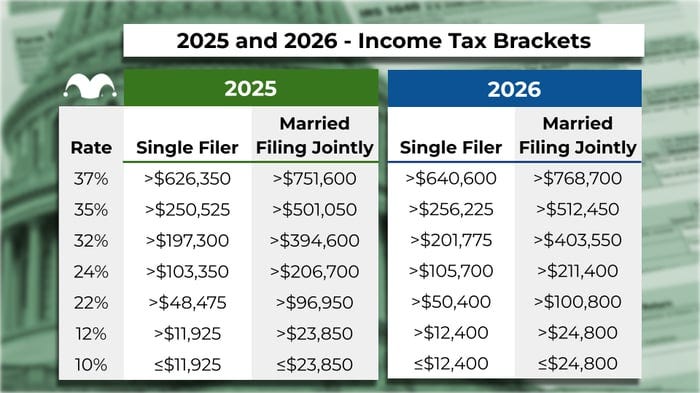
The fix is not complicated, it just takes attention. Every January, before the first paycheck of the year hits, pull up the new IRS bracket thresholds and compare them to where your income actually sits. If you are close to a line, that is where tax-advantaged accounts do their best work. A Traditional 401k contribution, an HSA deposit, a deductible IRA, these are not just retirement plays, they are bracket management tools. Dropping your taxable income by five or ten thousand dollars at the right moment can keep an entire chunk of your earnings from being taxed at the next rate up.
Here’s what that actually looks like in numbers.
Say you’re a single filer earning $128,000. After the ~$15,000 standard deduction, your taxable income is about $113,000. In 2026, the 22% bracket tops out around $103,350, so about $9,650 of your income is taxed at 24%.
Now shift $10,000 into pre-tax accounts before year end (for example, $6,000 to a Traditional 401(k) and $4,000 to an HSA). Your taxable income drops to $103,000, back under the 24% threshold.
The result:
That $10,000 avoids 24% tax this year
Federal tax savings: about $2,400
Plus potential state savings of ~$400 to $800
You didn’t earn less or work harder. You just moved income out of this year’s tax bucket. You got strategic.
That’s bracket management. Most people never use it. The ones who do keep more of what they make.
What Most People Actually Do With $3,100
The spending data on tax refunds is predictable and a little dispiriting.
Surveys consistently show three rough clusters: about a third of refund recipients plan to save it, about a third will put it toward debt, and about a third will spend it on goods or experiences. In the aggregate, that sounds reasonable. But the surveys capture intent, not behavior. And the behavioral reality is that lump sums sitting in a checking account do not stay there.
The Amazon cart that has been sitting at $289 for three weeks gets checked out. The trip that was “maybe this summer” gets booked. The new phone that was borderline justifiable suddenly crosses the line. These are not catastrophic decisions in isolation. But they are decisions that use a one-time lump sum to fund consumption rather than to meaningfully alter a financial trajectory.
And then January comes around, the withholding starts again, and eleven months later the exact same person files, receives the exact same refund, feels the exact same fleeting relief, and the cycle continues.
The IRS hangover is not just the day after Tax Day. It is a condition that renews itself every twelve months for people who never question the loop they are in.
Your Monday Morning Moves
Here is what I would do with a tax refund, in order of actual priority.
1. Adjust your withholding this week. Not this month, this week.
If you received a refund of more than $500, your W-4 is out of sync with your current financial life. That money could have been in your paycheck all year, sitting in a high-yield savings account at 4-plus percent, funding your Roth IRA monthly instead of as a lump sum scramble in April. Log into your employer portal, locate your W-4, and walk through the IRS withholding estimator at IRS.gov. The goal is not to owe a lot at Tax Day, it is to get as close to zero as possible, keeping your money in your hands all year. Owing a small, manageable amount at filing is not a problem. It means you kept your money longer.
2. Move a defined portion of the refund before it evaporates.
The day your refund hits your checking account, move a committed percentage, even 50%, even 30% to a separate, designated account before your brain starts generating creative justifications for why you deserve something.
Specific ideas: fund your Roth IRA for 2025 if you have not already (you had until April 15 to do that, if you missed it, open a 2026 contribution now), pad your emergency fund to the 3-to-6-month threshold, put it in a HYSA with a specific purpose label, invest it. The money has to move with intention before the checking account absorbs it into the noise of life.
3. Spend fifteen minutes doing a one-year tax audit on yourself.
Pull out your 2025 return or ask your tax preparer to send you a copy and look at three numbers: your adjusted gross income, your total tax owed, and your effective tax rate. Then ask one honest question: am I leaving deductions on the table? Common misses include student loan interest, self-employment expenses if you have any freelance or side income, HSA contributions, energy-efficiency home improvement credits, and educator expense deductions for teachers. If you find gaps, schedule a conversation with a CPA before Q4, not a tax prep chain, a CPA who will actually look at your specific situation. What you pay in taxes is not fixed. It is a function of how well you understand the rules of the game.
To Those Who Owed
To those who will not be receiving a tax refund, I feel your pain. I owed deep into five figures this year.
I am not typing that for sympathy and I am not typing it to brag. I am typing it because I want you to know that whatever number is sitting at the bottom of your return, whether it is four digits, five, or more, I understand the pit in your stomach. I had the same one.
And here is the thing I had to remind myself before I let the number ruin my weekend: I owe more because I made more.
That is not a consolation prize. That is the whole story. A big tax bill is not proof that you are losing. It is proof that you showed up, took the risk, worked hard, built the business, took the second client, asked for the raise, ran the numbers, and won. The bill is the shadow the success casts.
That does not mean you shrug and write the check. It means you take the win, take a breath, and then get strategic, because the difference between owing six figures again next year and owing far less is almost never about how much you made. It is about how much you planned.
After the Fog Clears
Every April, the country runs through the same ritual. File, wait, receive, breathe, spend. And then the next January arrives and the withholding starts again, and most people never stop long enough to examine the loop they are living inside.
The refund is not the story. The refund is evidence that the system is functioning exactly as designed, one that keeps the average person slightly confused, slightly reactive, and mildly grateful to receive their own money back on a schedule they did not set.
The most financially powerful version of you is not the one who celebrates the refund. It is the one who adjusts the withholding, moves the money with a plan, and refuses to stay in the cycle.
Tax season is officially over.
Your next one started yesterday.